
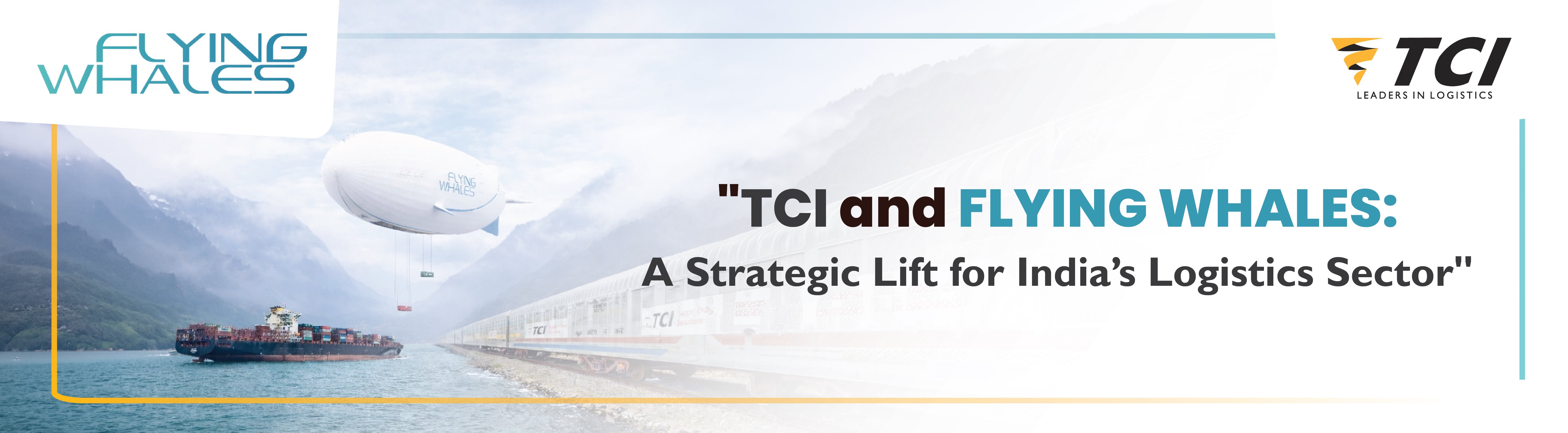
There was a time when logistics followed only one path - the road. Trucks moved along highways, trains crossed vast distances and ships connected ports across oceans. These systems built the backbone of modern trade and industry. Yet beyond these networks existed places where roads faded into narrow trails and access became uncertain mountainous terrains, remote regions, forests, islands and strategic border areas. In such places, logistics was not merely challenging, it was often delayed, expensive or sometimes impossible. But progress often begins with a question: What if logistics did not have to wait for infrastructure?
This question brought together TCI and FLYING WHALES in a shared vision to redefine how cargo moves across challenging terrains. This is the story of how the ground met the sky.
A New Possibility Takes Shape
For decades, logistics depended on infrastructure. Roads had to be built. Railways had to be laid. Airports had to be developed. Only then could cargo reach its destination. But in a country as geographically diverse as India, building infrastructure everywhere takes time. Remote locations often wait years before they become fully connected. The idea behind this collaboration was simple yet transformative: Instead of building roads to reach cargo, bring cargo directly to its destination.
This vision led to the introduction of the LCA60T Airship, a heavy-lift cargo airship designed to carry large and oversized loads directly to the point of need. With a payload capacity of up to 60 tons, the LCA60T represents a completely new category of logistics capability. Unlike conventional aircraft, it does not depend on runways or large ground infrastructure. It can hover in stationary flight and load or unload cargo directly at the delivery site. Mountains, forests, industrial zones or remote project locations, the destinations that were once difficult to access can now become reachable. Where roads cannot go, the sky can deliver.
Strength on the Ground
Technology alone does not transform logistics. It requires experience, infrastructure and execution capability. This is where TCI plays a critical role. Over the decades, TCI has built one of the country’s most extensive logistics ecosystems. With nearly 1,400 offices and a multimodal network covering road, rail, coastal shipping, air freight and warehousing, TCI has developed deep expertise in handling complex logistics operations.
From small shipments to large industrial equipment, TCI’s operations support industries across the country. Each day, cargo moves through a network designed to ensure reliability and efficiency even under demanding conditions. Now, this strong ground network is being integrated with a new dimension, the sky. Together, advanced airship technology and established logistics expertise create a powerful combination capable of transforming cargo mobility.
A Sustainable Approach to Heavy Logistics
Modern logistics must not only be efficient, it must also be sustainable. Traditional heavy transport often requires significant fuel consumption and infrastructure development, leading to higher environmental impact. As industries grow and infrastructure expands, the need for environmentally responsible logistics solutions becomes increasingly important. Airship-based logistics offers a promising alternative. By requiring minimal ground infrastructure and operating with lower fuel consumption compared to conventional heavy transport, airships can help reduce emissions and environmental disruption. This approach supports the growing need for logistics solutions that balance economic development with environmental responsibility. It is a step toward a future where growth and sustainability move together.
Supporting India’s Infrastructure Vision
The collaboration aligns closely with the goals of the PM Gati Shakti National Master Plan, a national initiative focused on improving infrastructure connectivity and logistics efficiency. By enabling direct delivery to remote and strategic locations, airship-based logistics can accelerate infrastructure development and improve accessibility. Projects that once required long transport cycles could move faster. Remote regions could gain improved access to essential equipment and supplies. Industries could expand into new areas with greater confidence. Instead of waiting for infrastructure to reach every corner of the country, logistics itself can become the bridge.
The People behind the Vision
Behind every major transformation are leaders who believe in what is possible. For TCI, the collaboration represents a continuation of its long-standing commitment to innovation and global partnerships. By working with international technology leaders, the company continues to strengthen its ability to deliver advanced logistics solutions. For Flying Whales Services, the partnership represents an important step in bringing airship technology to global markets. By combining advanced engineering with strong operational expertise, the collaboration aims to make heavy logistics more efficient and sustainable. Together, both organizations share a common goal, expanding the boundaries of logistics.
A Leap toward the Future
This partnership is more than a technological development. It is a leap: Beyond terrain, beyond infrastructure limitations, beyond traditional logistics models. It is a leap toward a more connected and resilient India. A future where geography is no longer a constraint. A future where accessibility is not limited by roads. A future where innovation and execution move together.
Moving More than Cargo
One day, a large cargo airship will rise slowly into the sky carrying equipment, materials, or supplies to a destination far from traditional routes. On the ground below, logistics networks will continue to operate, trucks moving along highways, trains crossing states, and warehouses managing flows of goods. But above them, a new dimension will exist. A dimension where logistics is no longer limited by terrain. Because logistics does not only move cargo. It moves industries. It moves infrastructure. It moves economies. And ultimately, It moves a nation forward.