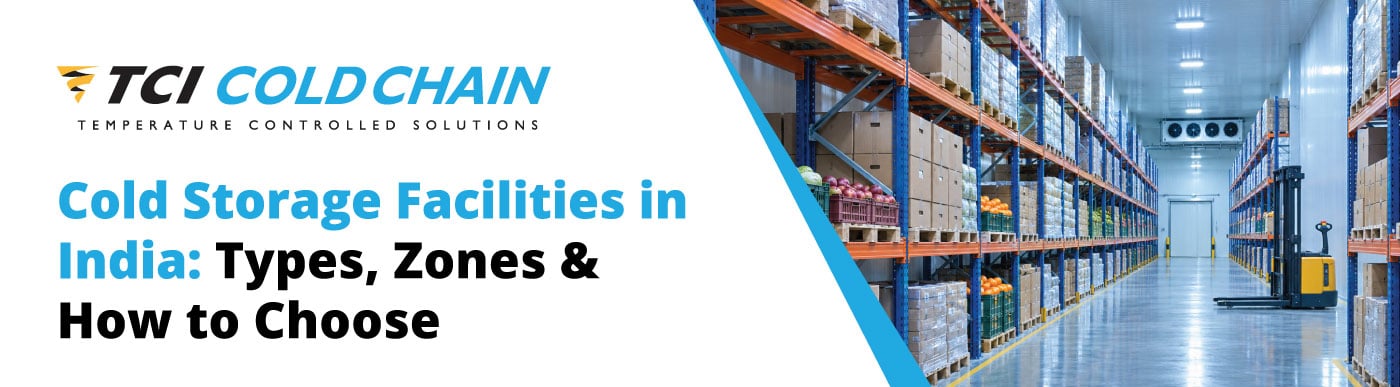
Types of Cold Storage Facilities in India and How to Choose the Right One
Cold storage facilities in India are temperature-controlled warehouses engineered to keep perishable goods - fresh produce, dairy, seafood, frozen foods, vaccines, and pharmaceuticals - within a precise, unbroken temperature range from the moment they arrive until they ship out.
In a country where a large share of horticultural output spoils before reaching consumers, these facilities are the backbone of food security, export competitiveness, and public health. This guide breaks down what cold storage facilities are, the temperature zones they operate across, the main types available, and a practical framework for choosing the right partner.
Key Takeaways: Cold storage facilities preserve perishables across defined temperature zones spanning roughly −25°C to +25°C. India operates 8,815 cold stores with 40.22 million tonnes of capacity, yet most is concentrated in a handful of states and dominated by a single crop. Matching the right facility type and temperature zone to your product - and vetting a provider on compliance, location, and continuity - is what protects margins and shelf life.
What Are Cold Storage Facilities?
A cold storage facility is a purpose-built, insulated structure that uses mechanical refrigeration to hold a controlled internal temperature - and often humidity - regardless of outside conditions.
Unlike an ordinary warehouse, it integrates compressors, evaporators, insulated panels, backup power, and temperature-monitoring systems to prevent any break in the cold chain. The goal is simple: slow biological and microbial activity so perishable goods retain quality, safety, and nutritional value for longer.
The economic stakes are enormous. Post-harvest losses in India's fruit and vegetable supply chains run high, and inadequate cold infrastructure is a leading cause. According to an ICRIER policy brief, post-harvest losses for perishable horticultural crops can reach 25–30%, translating into tens of thousands of crores of lost value every year.
A well-designed cold store directly attacks that loss by extending usable shelf life from days to weeks or months.
What Are the Different Temperature Zones in Cold Storage?
Cold storage temperature zones are standardised bands - deep frozen, frozen, chilled, cool, and controlled ambient - that map to what a product needs to stay safe. Vaccines and many biologics, for example, must never leave a narrow window. Per WHO/PAHO cold chain guidance, most vaccines must be held between +2°C and +8°C at every storage and distribution point, because both freezing and heat cause invisible, permanent damage.
Broadly, five working zones cover most commercial needs:
- Deep frozen (−25°C to −18°C): ice cream, seafood, and long-hold frozen meat.
- Frozen (−18°C to 0°C): frozen vegetables, ready meals, and processed poultry.
- Chilled (0°C to 4°C): dairy, fresh meat, and many vaccines and biologics.
- Cool / medium (4°C to 15°C): fruits, vegetables, flowers, and chocolate.
- Controlled ambient (15°C to 25°C): many pharmaceuticals, wines, and select dry goods.
What Are the Main Types of Cold Storage Facilities?
Types of cold storage differ by construction, temperature capability, and commercial model - from bulk single-commodity stores to multi-temperature distribution hubs. India's stock is heavily skewed toward one crop: as the India Brand Equity Foundation notes, a large majority of the country's cold storage capacity is dedicated to potatoes, leaving multi-commodity and pharma-grade capacity comparatively scarce and highly valuable.
Multi-commodity cold stores handle several temperature zones under one roof.
|
Type |
Best For |
Typical Zone |
|
Bulk / single-commodity store |
Potatoes, onions, apples |
Cool / chilled |
|
Multi-commodity store |
Mixed produce, dairy, packaged food |
Multiple zones |
|
Frozen & deep-freeze store |
Seafood, meat, ice cream |
Frozen / deep frozen |
|
Controlled atmosphere (CA) |
Apples, kiwis, long-hold fruit |
Cool, gas-regulated |
|
Pharma / GDP-compliant store |
Vaccines, biologics, medicines |
Chilled / ambient |
|
Distribution / reefer hub |
E-commerce, quick-commerce grocery |
Multiple zones |
Controlled-atmosphere stores add another layer, regulating oxygen and carbon-dioxide levels alongside temperature to hold fruit for months. Pharma-grade facilities, meanwhile, must meet Good Distribution Practice standards with validated mapping, redundant cooling, and audit-ready records - a different discipline entirely from bulk agri storage.
How Big Is India's Cold Storage Landscape?
India's cold storage network is sizeable but uneven. Drawing on National Centre for Cold-chain Development data, the International Institute of Refrigeration reports that as of mid-2025 India had 8,815 cold storages with a combined capacity of 40.22 million tonnes, expanding at a modest 2.2% compound annual growth rate - a pace that trails demand and leaves clear regional gaps.
Demand is climbing fast on the back of organised retail, quick-commerce grocery, dairy, and pharmaceuticals. Market research summarised by PR Newswire projects India's cold chain market to reach roughly ₹5.06 trillion by 2028 at an 18.25% CAGR. That gap between fast-growing demand and slow-growing capacity is precisely why choosing the right facility now carries strategic weight.
How Do You Choose the Right Cold Storage Facility?
Choosing a cold storage facility comes down to matching temperature capability, location, compliance, and operational continuity to your specific product. With India's cold chain market compounding at double digits, capacity is tightening - vet providers on continuity and certifications, not just price per pallet, because a cheaper store that breaks the chain once can destroy an entire consignment's value.
Work through these criteria before signing:
- Temperature and zone fit: Confirm the facility holds your exact zone (chilled, frozen, CA) with validated temperature mapping, not just a nominal setpoint.
2. Location and reach: Proximity to sourcing regions, consumption markets, and reefer transport routes reduces transit risk and last-mile spoilage.
3. Compliance and certifications: Look for FSSAI registration and, for medicines, GDP/GMP-aligned processes with audit trails.
4. Backup power and monitoring: Redundant DG sets and real-time IoT temperature logging protect against outages and provide traceable records.
5. Scalability and integration: Providers that combine storage with refrigerated transport simplify handovers and keep the chain unbroken end to end.
For shippers who need storage and refrigerated logistics under one roof, TCI Cold Chain offers integrated cold chain and temperature-controlled logistics services that can remove the riskiest link of all - the handover between separate storage and transport vendors.
Frequently Asked Questions
What temperature is a standard cold storage facility?
There is no single standard - facilities operate across zones. Chilled storage typically runs 0°C to 4°C for dairy and fresh meat, frozen storage sits between −18°C and 0°C, and deep-freeze chambers reach −25°C for seafood and ice cream. The correct temperature depends entirely on the product being stored.
Why is cold storage important for India's food supply?
A significant share of India's fruits and vegetables is lost after harvest, largely because of inadequate refrigeration. Cold storage extends usable shelf life from days to weeks or months, reduces waste, stabilises prices across seasons, and makes agricultural exports viable by keeping produce within safe temperature ranges throughout the journey.
What is the difference between cold storage and refrigerated logistics?
Cold storage refers to stationary temperature-controlled warehousing, while refrigerated logistics - reefer trucks and containers - moves goods between points. Both are parts of the same cold chain. A break in either link exposes perishables to temperature abuse, so integrated providers that manage both reduce spoilage risk.