 Choosing Between 3PL and 4PL for Your Supply Chain
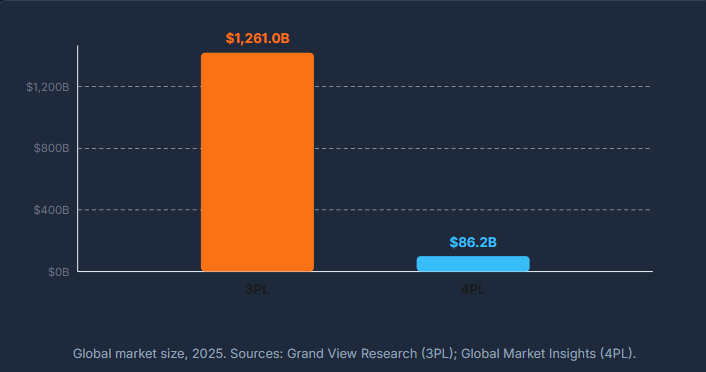
In December 2025, Gartner published its first-ever Magic Quadrant for Fourth-Party Logistics - a clear signal that 4PL has moved from a niche consulting term to a category enterprises actively shop for (Gartner, via FreightWaves, December 2025). At the same time, the global 3PL market alone is valued at over $1.2 trillion in 2025 - more than fourteen times the size of the entire 4PL market (Grand View Research; Global Market Insights, 2025).
That gap tells you something important: most businesses still need a 3PL. A smaller, faster-growing group needs something more - one team managing every carrier, warehouse, and system they've accumulated. This comparison breaks down what actually separates the two models, where each wins on cost, control, and complexity, and how to decide which fits your business. We drew on how logistics providers structure 3PL and 4PL contracts across retail, chemical, automotive, and aviation supply chains to build this comparison.
TL;DR: 3PL wins when you need a partner to execute logistics - warehousing, transport, fulfillment - under your direct control, and at lower cost. 4PL wins when your supply chain has outgrown a single provider and you need one team orchestrating multiple 3PLs, carriers, and systems. Choose 3PL if you want hands-on control. Choose 4PL if coordination itself has become your bottleneck.
3PL vs 4PL: Quick Comparison Table
Before the detailed breakdown, here's how the two models stack up across the factors that actually drive a decision.
|
Category |
3PL |
4PL |
|
Best For |
Execution - warehousing, transport, fulfillment |
Orchestrating multiple providers and systems |
|
Control |
High - you set strategy, 3PL executes |
Lower - 4PL sets and runs strategy |
|
Asset Ownership |
Owns/operates warehouses and fleets |
Typically asset-light; coordinates others' assets |
|
Contract Structure |
Direct service contract |
Often a joint venture or long-term partnership |
|
Global Market Size (2025) |
$1,261.0B (Grand View Research) |
$86.2B (Global Market Insights) |
|
India Market Size (2025) |
$24.87B (IMARC Group) |
Folded into India's wider logistics market; standalone data still thin |
|
Technology |
Provider's own WMS/TMS |
Neutral control tower across every provider's systems |
|
Onboarding Time |
Weeks |
Months - multi-party integration |
|
Best Use Case |
Regional/national fulfillment, warehousing, single-mode transport |
Multi-carrier, multi-country, multi-vendor supply chains |
|
Our Verdict |
Wins for most businesses today |
Wins for complexity at scale |
What Is 3PL Logistics?
3PL logistics is when a business outsources physical logistics operations, such as warehousing, transportation, and order fulfillment, to a third-party provider that owns or operates its own trucks, warehouses, and technology (CSCMP Supply Chain Glossary). It's already the default model in India: 3PL accounts for roughly 48% of the country's $228.4 billion logistics market as of 2025 (IBEF).
A 3PL provider typically handles one or more of: warehousing and inventory management, inbound/outbound transportation, freight forwarding, and order fulfillment. It's asset-based: the trucks, warehouses, and often the technology belong to the provider, not you. That's what makes it fast to onboard. You're plugging into infrastructure that already exists, whether that's retail logistics, chemical transportation services, or automotive logistics services.
Here's what most comparisons miss: 3PL isn't a single tier of service. A retail brand using a 3PL for e-commerce fulfillment and a chemical manufacturer using a 3PL for hazmat-compliant transport are buying fundamentally different capabilities under the same three-letter label. Vertical specialization, not just scale, is what separates a good 3PL from a generic one.
What Is 4PL Logistics?
4PL logistics is when a single provider manages and coordinates your entire supply chain, including multiple 3PLs, carriers, and technology systems, rather than executing the physical movement itself. CSCMP defines the 4PL relationship as often structured as a joint venture or long-term contract, acting as the single interface between a client and multiple logistics providers, ideally managing all aspects of that client's supply chain.
The term isn't new. Accenture (then Andersen Consulting) coined and trademarked "4PL" back in 1996, but it stayed a consulting-heavy niche for nearly three decades. That changed in December 2025, when Gartner published its inaugural Magic Quadrant for Fourth-Party Logistics, explicitly framing 4PLs as end-to-end supply chain orchestrators distinct from 3PLs (FreightWaves, December 2025). CSCMP also notes that a major 3PL can run a 4PL unit inside its own structure. The two models aren't mutually exclusive.
A 4PL is often called a "lead logistics provider" (LLP), a term CSCMP uses to describe an organization that sits above individual 3PLs and carriers, owning the strategy, technology, and coordination layer of a client's supply chain rather than the trucks and warehouses that move the freight.
The pattern worth noticing: nearly every major 4PL launch traces back to a moment of supply chain crisis, not steady growth. Accenture coined the term during 1990s outsourcing waves. Gartner formalized the category in December 2025 amid tariff volatility. 4PL adoption tends to follow disruption, not planning cycles.
Which Gives You More Control - 3PL or 4PL?
3PL wins on control. Because you're contracting directly for specific services (storage, transport, fulfillment), you set the strategy and the 3PL executes against your instructions. Want to switch carriers, change SLAs, or renegotiate rates? You're dealing with one provider directly.
4PL flips that. You're handing the orchestration layer, including carrier selection, routing decisions, and the technology stack, to the 4PL. That's the entire value proposition: you stop managing five vendor relationships and manage one. But it also means less day-to-day visibility into individual decisions, and more dependence on the 4PL's judgment.
Verdict: 3PL wins for businesses that want hands-on control. 4PL wins when managing that control yourself has become the actual problem.
Which Offers Better Visibility and Technology?
4PL wins on cross-provider visibility. Gartner's reasoning for launching a dedicated 4PL Magic Quadrant in December 2025 centers on exactly this: enterprises now run a TMS, ELDs, visibility tools, and pricing engines that "don't talk to each other in real time" (Gartner, via FreightWaves, December 2025). A 4PL's core job is building the control tower that unifies those fragmented systems into one view.

A single 3PL's technology is usually excellent - but it's scoped to that one provider's operation. If you run three regional 3PLs plus a handful of carriers, you get three (or more) separate dashboards, not one. That fragmentation is invisible when you're small. It becomes the bottleneck once you're not.
Verdict: 3PL wins if a single provider covers your whole footprint. 4PL wins the moment you're stitching together more than two or three providers.
Which Scales Better as Complexity Grows?
4PL wins on scalability. A 3PL relationship scales cleanly within one provider's network - more volume, more warehouse space, more trucks. It scales far less cleanly across providers, countries, and modes, because every new 3PL or carrier you add is another system, another SLA, and another point of failure.
This is precisely the driver Gartner cites for 4PL's rise: tariff volatility and multi-carrier, multi-system fragmentation are pushing enterprises to hand orchestration to a dedicated layer rather than absorb the coordination cost internally. Globally, 87% of shippers now outsource some logistics function - but only 66% say that outsourcing actually reduced their overall costs, and coordination overhead is a common reason why it doesn't (NTT DATA / Penn State / Penske, 2025 Third-Party Logistics Study).
Verdict: 3PL wins for a single-region, single-mode operation. 4PL wins once you're managing complexity across providers, geographies, and systems.
Which Is Better for Regulated Cargo - Chemical, Automotive, Aviation?
3PL wins for specialized execution; 4PL wins for coordinating specialists at scale. Regulated and time-critical cargo rewards a hands-on operator who lives inside the compliance detail - a 3PL is usually the right layer here.

India's chemical transportation services market alone is valued at $8.57 billion in 2024, growing partly because chemical manufacturers are outsourcing hazardous-material distribution to 3PLs that already carry the compliance certifications and specialized fleet needed for safe handling (IMARC Group).
Automotive logistics services follow a similar pattern - just-in-time delivery to assembly lines needs a specialist that understands sequencing, not a generalist. Aviation logistics, covering time-critical parts and AOG (aircraft-on-ground) shipments, works the same way: speed and precision matter more than orchestration breadth.
Where 4PL earns its place in regulated cargo is scale - a global automotive OEM coordinating dozens of Tier 1 and Tier 2 suppliers across multiple countries genuinely needs one team unifying all of it. But that's the exception, not the norm, for most regulated-cargo shippers.
Verdict: 3PL wins for most regulated and specialized cargo. 4PL only wins once you're coordinating many specialist providers across borders.
Which Offers Better Warehousing Support?
3PL wins on warehousing. Warehousing is core, owned infrastructure for most 3PLs - not a coordination layer, which is where 4PL adds value instead. India's Grade A warehousing supply is projected to top 300 million square feet by 2025, with industrial and warehousing demand up 63% year-on-year in H1 2025 (IBEF, citing CBRE).
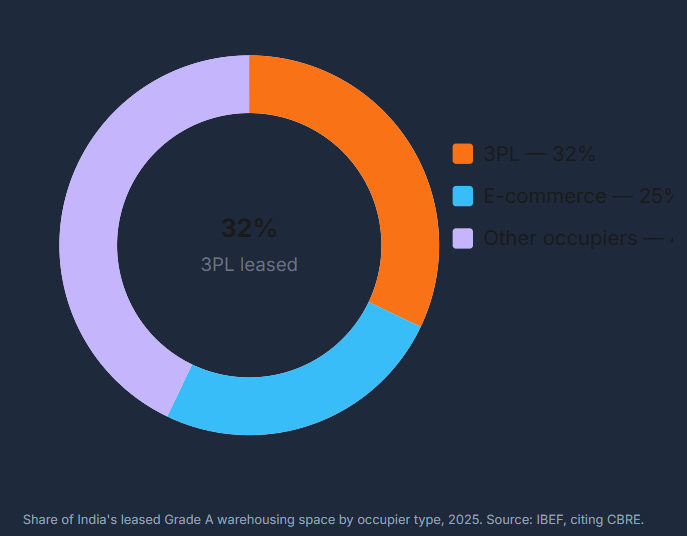
3PL players account for 32% of leased warehousing space in India - more than any other single occupier category, including e-commerce at 25% (IBEF / CBRE). A 4PL rarely leases warehouse space directly; it coordinates the 3PLs that do.
Verdict: 3PL wins decisively on warehousing. It's the model built to own and operate storage - not to broker it.
3PL vs 4PL Pricing: What Actually Costs More?
3PL pricing is transactional - you pay per pallet stored, per shipment moved, per order fulfilled. That's why it's the easier model to justify to a finance team: costs scale directly with volume, and 94% of domestic Fortune 500 companies now work with at least one 3PL, up 46% since 2001, which has pushed pricing toward efficient, competitive benchmarks (Armstrong & Associates).
4PL pricing layers a management and orchestration fee on top of the underlying 3PL and carrier costs it coordinates. That sounds like it should always cost more - and per-shipment, it often does. But the comparison that matters isn't 3PL fee versus 4PL fee; it's 4PL fee versus what it currently costs you internally to manage five vendor relationships, reconcile five sets of data, and absorb the errors that fall through the cracks between them.
For shippers using 3PLs today, 66% report reduced overall logistics costs and 82% report improved customer service (NTT DATA / Penn State / Penske, 2025) - the same efficiency logic is what a 4PL is trying to extend across providers you already use.
Verdict: 3PL costs less at the invoice level. 4PL can cost less overall once internal coordination overhead is priced in - but that's a scale-dependent calculation, not a given.
Who Should Choose What
If you're still weighing 3PL vs 4PL supply chain fit, match your situation to one of these profiles.
A growing retail logistics company or D2C/omnichannel brand: choose 3PL. You need warehousing services and regional fulfillment more than cross-provider orchestration - a single 3PL relationship gets you to market faster.
A chemical manufacturer moving hazardous or regulated materials: choose a 3PL that specializes in chemical transportation services, where compliance depth matters more than orchestration breadth.
An automotive OEM or Tier 1 supplier running just-in-time delivery: a regional 3PL handles single-plant JIT well; a global OEM coordinating dozens of suppliers across countries should evaluate 4PL orchestration instead.
An aviation or high-value time-critical shipper: choose a 3PL built for aviation logistics - speed and precision on AOG and spares shipments beat broad coordination every time.
An enterprise already running five or more carriers or regional warehouses: choose 4PL. If coordination has become a full-time internal job, that's the signal you've outgrown the 3PL model on its own.
If none of these quite fit - you're small, single-region, and just need reliable supply chain management services without complexity - start with a 3PL and revisit 4PL only once coordination genuinely becomes the bottleneck, not before.
Frequently Asked Questions
What is the difference between 3PL and 4PL?
A 3PL executes logistics - it owns or operates the warehouses, trucks, and technology that move and store your goods. A 4PL manages and coordinates multiple 3PLs, carriers, and systems on your behalf, acting as a single point of accountability for the entire supply chain (CSCMP).
Is 3PL or 4PL better for my business?
Neither is universally better. 3PL wins for most businesses - it's faster to onboard, cheaper to start, and gives you direct control. 4PL wins once you're juggling multiple carriers, warehouses, or countries and coordination itself has become the bottleneck. Gartner's first 4PL Magic Quadrant (December 2025) confirms this is now a distinct enterprise buying category.
What is a 3PL vs a 4PL in terms of who owns the assets?
A 3PL typically owns or leases the physical assets - warehouses, fleets, fulfillment centers - used to move your goods. A 4PL is usually asset-light: it's often structured as a joint venture or long-term partnership sitting above the 3PLs and carriers, owning the strategy and technology layer rather than the trucks (CSCMP).
Can a business use 3PL and 4PL together?
Yes. CSCMP notes that a large 3PL can operate a 4PL unit within its own structure, and plenty of enterprises run both - a 4PL layer coordinating several underlying 3PLs across regions or service lines. It's a common hybrid, not an either/or choice.
Is 4PL only for large enterprises, or is it worth it in 2026?
4PL still skews toward large, multi-region enterprises - the global 4PL market ($86.2B in 2025, Global Market Insights) is a fraction of 3PL's ($1,261B, Grand View Research). But Gartner's inaugural 4PL Magic Quadrant in December 2025 signals the category is maturing quickly, driven by tariff volatility and fragmented multi-carrier systems.
The Verdict: 3PL vs 4PL by Category
|
Category |
Winner |
|
Control |
3PL |
|
Visibility & Technology |
4PL |
|
Scalability & Complexity |
4PL |
|
Regulated / Specialized Cargo |
3PL |
|
Warehousing |
3PL |
|
Entry-Level Cost |
3PL |
|
Overall |
3PL for most businesses; 4PL for multi-provider enterprise complexity |
3PL remains the right starting point for the vast majority of Indian businesses - it's why 3PL still commands 48% of India's logistics market against a much smaller, if faster-growing, 4PL footprint (IBEF). 4PL earns its premium only once coordination complexity, not execution capacity, is the actual constraint on your supply chain.
Not sure which side of that line your business is on? TCIL's logistics services span 3PL execution - retail, chemical, automotive, and aviation - and the warehousing and supply chain management infrastructure both models depend on. Talk to us before you commit to either.